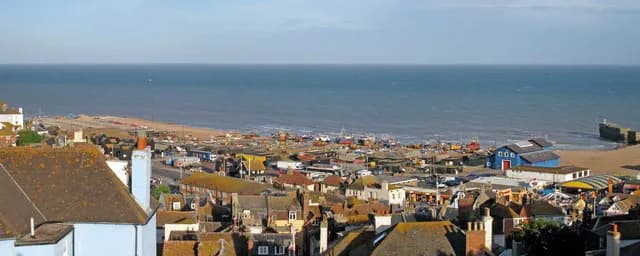
Hastings is home to the largest beach-launched fishing fleet in Britain. For at least 400 years, and possibly as many as 600, fishermen have dragged their boats across the shingle at the Stade to reach the waters of Rye Bay.
A Harbour That Never Was
The story of Hastings' beach fleet begins with what the town lacks: a natural harbour. While other fishing ports developed around sheltered anchorages, Hastings fishermen have always worked from the open beach beneath the cliffs.
Attempts to build a stone harbour stretch back to the reign of Elizabeth I. Each endeavour failed. The most recent effort began in 1896, when a foundation stone was laid for a substantial concrete structure. Rising costs and structural problems brought the project to a halt. The remains of this ambition, a fractured seawall known locally as the Harbour Arm, still stand. It was partly demolished during the Second World War to prevent potential use by invasion forces.
Without a harbour, the fishermen adapted. They developed methods of hauling wooden boats across the steep shingle beach that have remained largely unchanged for centuries.
How the Fleet Works
The Hastings fleet operates approximately 20 boats, making it the largest beach-launched fishing fleet in the United Kingdom. The vessels are registered at Rye and carry the prefix "RX" for Rye, SusseX on their hulls.
Launching and retrieving boats from a shingle beach requires considerable labour. The boats are traditionally hauled up above the high tide line for storage and maintenance. When conditions are right, crews drag the vessels down to the water, often using winches and capstans. The method is weather-dependent; heavy seas or strong winds can keep the fleet shorebound for days.
The boats themselves are designed for these conditions. They are sturdy, compact vessels capable of withstanding both the shingle and the open waters of the English Channel. The proximity to Rye Bay, a prolific fishing ground, has sustained the fleet through centuries of change.
Modern Challenges and Accreditation
The Hastings fleet has faced the same pressures as fishing communities across the country. Quota systems, changing marine regulations, and environmental concerns have all shaped the industry.
In recent years, the fleet received accreditation for its sustainable fishing methods. This recognition acknowledges that the traditional techniques employed by Hastings fishermen have a lower environmental impact than industrial-scale operations. The small-scale nature of the beach fleet, combined with centuries of accumulated local knowledge about the fishing grounds, supports this sustainability claim.
A Living Heritage
The fishing community has left its mark on Hastings beyond the boats on the beach. The Fishermen's Museum occupies the former fishermen's church near the Stade, preserving the history of the industry and the families who have worked these waters across generations.
The fleet remains a working concern, not a heritage attraction. Visitors to the Old Town can watch the boats being prepared, launched, and repaired. The sight of wooden vessels pulled high on the shingle, with the East Hill cliffs rising behind, has become one of the defining images of Hastings.
For the fishermen, the beach launch is not tradition for its own sake. It is the practical solution to a geographical reality that has shaped Hastings for half a millennium.