A Seafront Landmark Born from Maritime Romance
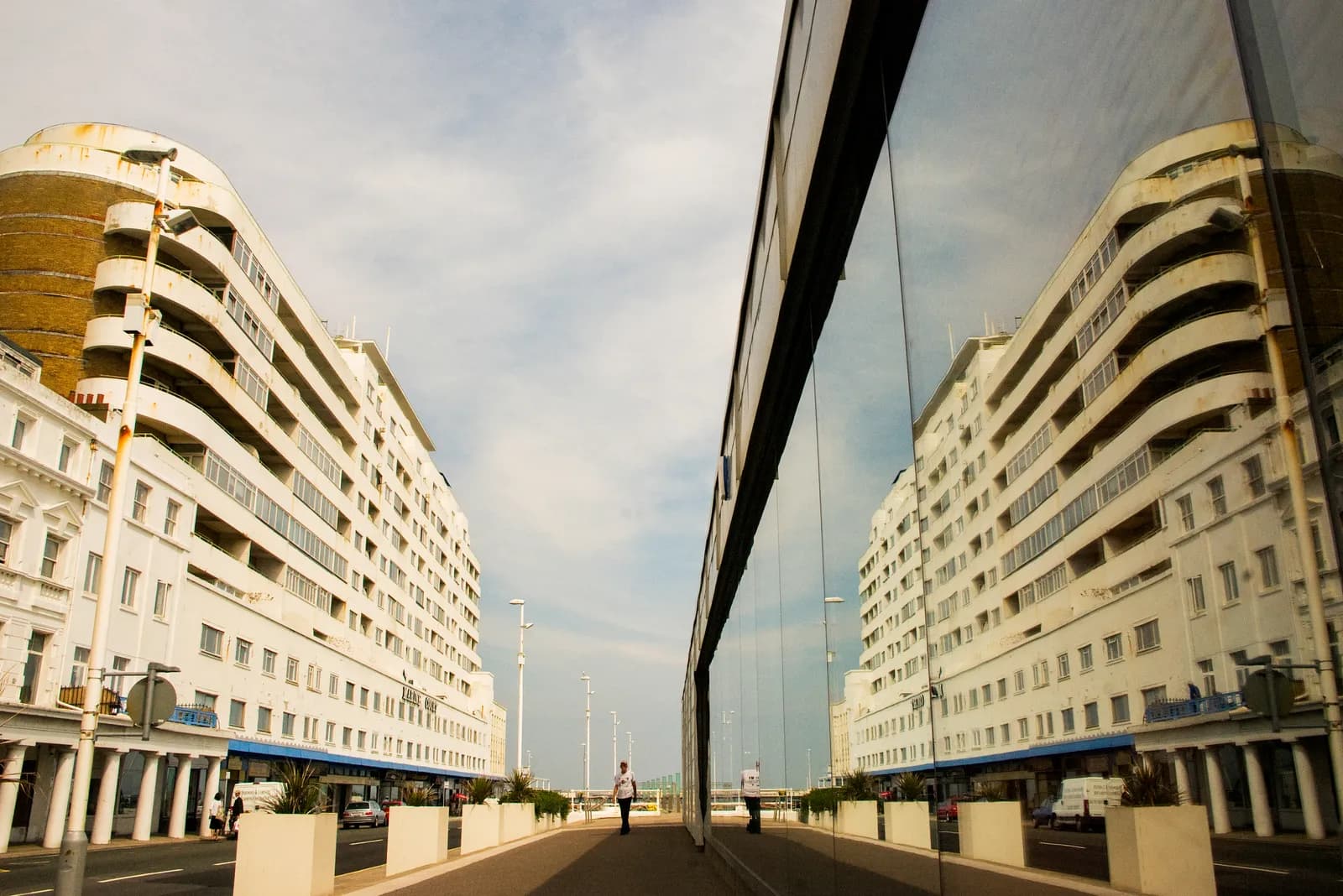
Rising 170 feet above the St Leonards seafront, Marine Court remains one of the most distinctive buildings on the south coast. Completed in 1938, this 14-storey Art Deco apartment block was deliberately modelled on the RMS Queen Mary, the Cunard ocean liner that had captured public imagination just two years earlier.
Ambitious Origins
The building emerged from the vision of South Coast (Hastings and St. Leonards) Properties Ltd, a development company that commissioned architects Kenneth Dalgleish and Roger K. Pullen to create something unprecedented. The foundation stone was laid on 30 November 1936 by Robert Holland-Martin, Chairman of Southern Railway, and the structure was completed in 1938 at a final cost of nearly £500,000.
Construction was an engineering feat for its era. The building required 2,100 tons of steel, 2,000 tons of cement, and 1.4 million bricks. Eight hundred men were employed directly on the project. The structure rose on the site of 14 Victorian houses at 22–32 Marina, which developer Commander Bray had purchased for the purpose.
The resulting edifice stretched 416 feet along the seafront, with curved ends resembling a ship's bridge and balconies stepping back like promenade decks. Original Crittall metal windows and a white-painted exterior completed the ocean liner aesthetic. A promotional brochure of the era was reportedly titled "Hymn to the Sun," capturing the optimism of the design.
The Residential Hotel Vision
Marine Court was conceived not merely as flats but as a "residential hotel," promising liveried porters, valets, waiters, and maids. The ground floor housed 20 shops beneath a concrete canopy. A two-floor restaurant could seat 1,000 diners and host dances, with a separate entrance for non-residents. Additional amenities included a large public lounge, reading and writing rooms, and a rooftop bar.
The flats were marketed as "ultra-modern" and "all-electric," featuring central heating, gas cookers, refrigerators, and a central boiler for hot water. A duct-and-fan system provided what was described as "air-conditioning." At completion, it stood as the tallest residential building in Britain.
The design proved controversial from the outset. Local residents opposed the project, and uptake of flats was slower than projected. The development company eventually folded with debts of £333,000.
War and Its Shadow
The outbreak of the Second World War in 1939 brought a dramatic change of purpose. Marine Court was requisitioned by the military and became the headquarters of RAF No. 1 Initial Training Wing under Acting Air Commodore Alfred Critchley.
On 24 September 1942, tragedy struck when seven Focke-Wulf Fw 190s attacked the Hastings seafront. A bomb hit the eastern end dining room, killing three cadets and injuring approximately twelve others. The training wing was subsequently relocated to Harrogate, Yorkshire. Bomb damage was not repaired until 1949–50.
Post-War Transformations
After the war, the building transitioned to residential use as flats and apartments. The grand restaurant was converted to a nightclub called Witch Doctor in the 1960s, where David Bowie and The Who performed. By the century's end, the structure showed its age. Piecemeal window replacements and balcony enclosures had given the building what preservationists described as a "disharmonious appearance."
Grade II listing was granted on 9 November 1999, recognising Marine Court's architectural significance. In 2006, Hastings Borough Council published a five-year Conservation Management Plan. When management agents became bankrupt, residents established their own management company in 2010 to take control of the building's future.
A Conservation Landmark
Today Marine Court remains a residential apartment block with active ground-floor shops, managed by its residents. The building exemplifies the Streamline Moderne style, a branch of Art Deco architecture that emphasised horizontal lines, curved forms, and nautical inspiration.
The structure occupies a prominent position on the St Leonards seafront, visible from considerable distances along the coast. Its ocean liner silhouette continues to generate what cultural historians have termed "nautical fantasies," a stationary monument to the romance of transatlantic travel that inspired its creation.
For Hastings, Marine Court represents both architectural ambition and the challenges of preserving modernist heritage. The building's story encompasses the optimism of the 1930s, the disruption of war, the cultural shifts of the post-war decades, and the ongoing efforts of residents to maintain a landmark that remains, in essence, an ocean liner that never sailed.