In the early nineteenth century, a triangular patch of foreshore in Hastings became an unlikely republic. Known as the America Ground, this approximately eight-acre area hosted a self-governing community that raised the Stars and Stripes in defiance of British authority.
The Land That Stood Outside the Law
The America Ground occupied the space now bounded by Robertson Street, Carlisle Parade, Harold Place, and Claremont. Before the great storm of 1287, this area had formed part of the river mouth of the Priory Stream, which created a natural harbour. The storm deposited vast quantities of shingle, gradually creating new land that sat ambiguously between sea and shore.
By the early 1800s, this territory fell outside the official boundaries of Hastings Borough. Its western limit was marked by Priory Bridge, and beyond it lay what residents called "No Man's Land"; a place without magistrates, without rents, and without the reach of local authorities.
Squatters, Builders, and a Makeshift Republic
The first recorded inhabitants arrived in 1806. Thomas Page and John Prior made their homes in an old hulk, the remains of the brig Polymina, which they converted into two dwellings. They were soon joined by itinerant builders employed in the construction of Pelham Crescent and the new town of St Leonards. These workers, finding no available accommodation, settled on the foreshore without permission or payment.
The population grew rapidly. By the 1820s, nearly 200 buildings housed over 1,000 residents. The community developed its own economy: ropewalks belonging to Thwaites & Co. and Breeds & Co. stretched 120 to 150 fathoms across the ground. There were lodging houses, limekilns, stonemasons, a tallow factory, sawing houses, and butchers with slaughterhouses and piggeries. Daniel Thomas ran the Black Horse gin palace, whilst William Parker founded a small school that would eventually become Hastings Grammar School.
The Flag of Independence
The America Ground earned its name from an act of defiance. When bailiffs crossed Priory Bridge to arrest suspected felons, the inhabitants rioted and chased the officials back across the boundary. In a gesture that deliberately echoed the recent American Revolution, they raised the Stars and Stripes as a symbol of their independence from British law.
The flag remained flying throughout the occupation. Local lore suggests the residents viewed themselves as a separate nation, free from taxes, rents, and the constraints of the borough. J. Manwaring Baines, in his work "Historic Hastings", records an exchange between Pierwarden Charles Picknell and counsel at the subsequent inquiry: "You were not thought respectable then, if you were not a smuggler." The witness added that even parsons would "take a keg for Christmas sometimes."
Three Claims, One Outcome
The legal status of the America Ground was contested from the start. Some occupiers held leases from Lord Chichester, who claimed the entire area under a grant from James I. Others had permission from the Corporation of Hastings under a grant from Elizabeth I. The Crown also asserted ownership.
On 5 November 1827, an inquisition convened at the George Hotel in Battle to settle the matter. The commission determined that the land belonged to the Crown. Adjacent landowners, including the Cornwallis and Eversfield Estates, maintained their own claims, but the verdict favoured the sovereign.
Notices were served in May 1828, giving occupants the opportunity to prove their claims. Most could not. Some received seven-year leases, but the reprieve proved temporary.
Eviction and Clearance
On 13 November 1834, the Woods and Forests Commissioners delivered an ultimatum. All buildings remaining after Michaelmas 1835 would be forfeit. The ground was cleared of inhabitants and structures by Christmas that year.
The eviction was not merely destructive. Many residents relocated their homes piece by piece to St Leonards, rebuilding in Gensing Road, Norman Road, Shepherd Street, North Street, and London Road. Approximately twenty-eight buildings made the journey across the boundary.
The America Ground then lay derelict for fifteen years, hosting only occasional cricket matches and the annual Rock Fair on 26 and 27 July. It became known simply as the Waste or the Derelict Lands.
A New Beginning
In 1849, real estate developer Patrick Francis Robertson secured a ninety-nine-year lease on the Crown lands at £500 per year. Plans drawn up by the architectural partnership Reeks Humbert in 1850 saw Robertson Street, Carlisle Parade, and Robertson Terrace rise within six months. Lord Carlisle, Chief Commissioner of Woods and Forests, gave his name to Carlisle Parade.
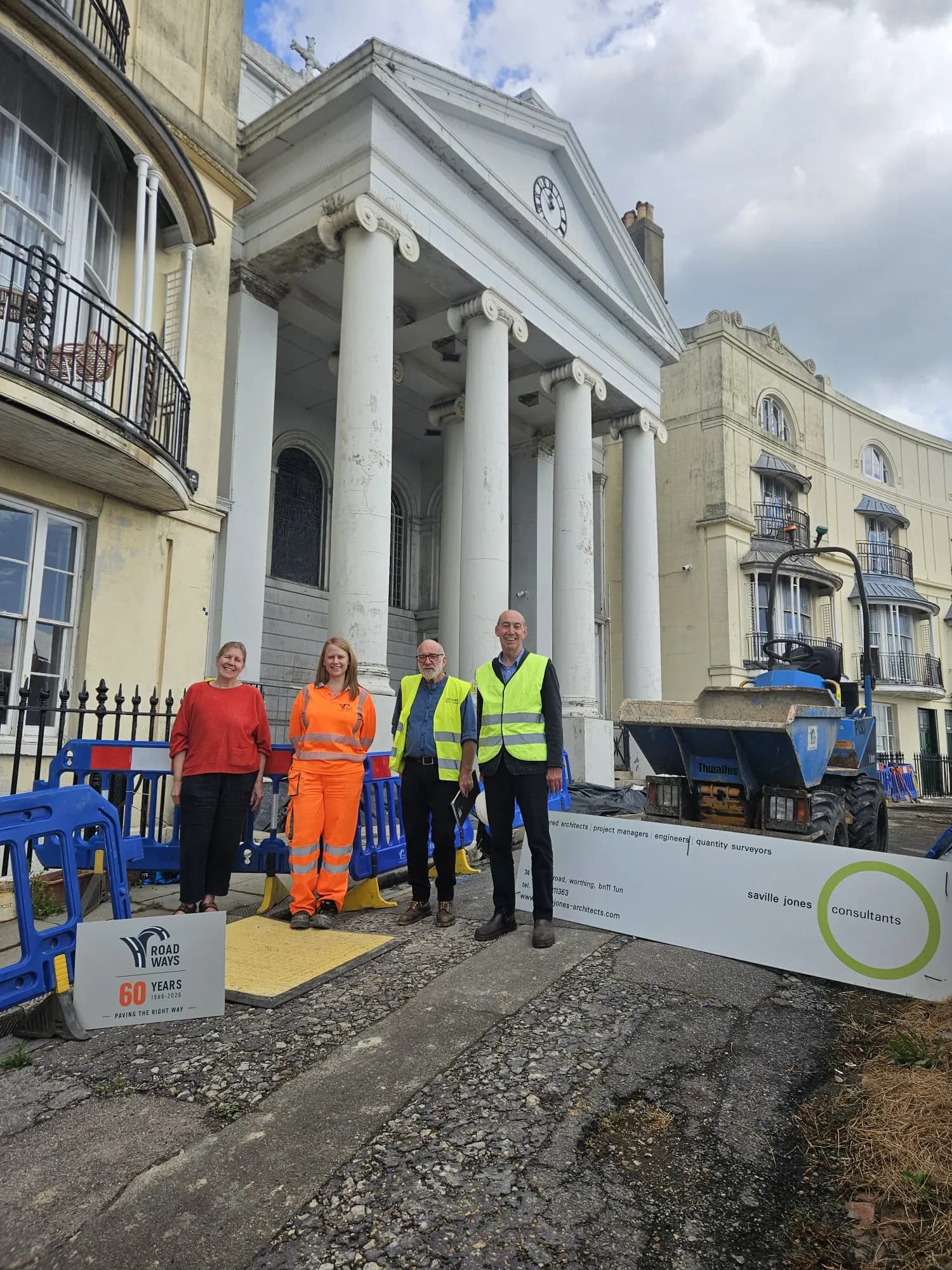
The Victorian redevelopment transformed the area. The Brassey Institute, the Observer Building, Holy Trinity Church, and Robertson Street United Reformed Church now stand where squatters once governed themselves. Minimal architectural change has occurred over the past century, preserving the nineteenth-century streetscape.
Memory and Commemoration
The America Ground has not been forgotten. A mural at Robertson Passage commemorates the area's history. Since 4 July 1999, the American flag has been raised annually, accompanied by a reading of the American Declaration of Independence. The Hastings Bonfire Society, reformed in 1995, continues the tradition of the Town Crier reading a declaration written by local historian Dennis Collins during the annual bonfire procession.
Recent community projects, including "The Alley" in the passageway locally known as "Gotham Alley", have opened up spaces for art and performance, echoing the self-organising spirit of the original America Ground.
What began as a refuge for itinerant builders became a symbol of independence, a legal battleground, and eventually a respectable Victorian town centre. The America Ground remains one of Hastings' most unusual chapters: a moment when a corner of Sussex declared itself sovereign soil.