The Author Behind the Masterpiece
Robert Tressell was the pen name of Robert Phillipe Noonan, a house painter and signwriter who lived and worked in Hastings from 1902 until his death in 1911. Born in Dublin on 17 April 1870, he adopted the pseudonym as a play on "trestle table," an essential part of any painter and decorator's kit. His time in Hastings would prove to be the most productive and politically significant period of his life.
Hastings Addresses and Daily Life
Tressell arrived in Hastings in late 1901 or early 1902 with his daughter Kathleen and initially stayed with his sister Mary Jane at 38 Western Road, St Leonards. In 1902, he moved to 1 Plynlimmon Road before settling at 115 Milward Road between 1903 and 1907. The top flat in Grosvenor Mansion, with its three attics, became his primary residence and likely his writing space. His final Hastings address was 241 London Road, above a cycle shop, where he lived from 1908 to 1910.
Employment as a Decorator
Throughout his decade in Hastings, Tressell worked for several local firms including Bruce & Co at 2 York Buildings and Burton & Co on Stonefield Road, where he also wrote coffin plates. From late 1906, he worked for Adams and Jarrett on Norman Road and Alfred Street. His skills as a decorative painter were evident in his renovation of the chancel at St Andrews Church on Queens Road at Easter 1905. Fragments of his decorative work from this period survive today in the collection at Hastings Museum and Art Gallery.
The Ragged Trousered Philanthropists
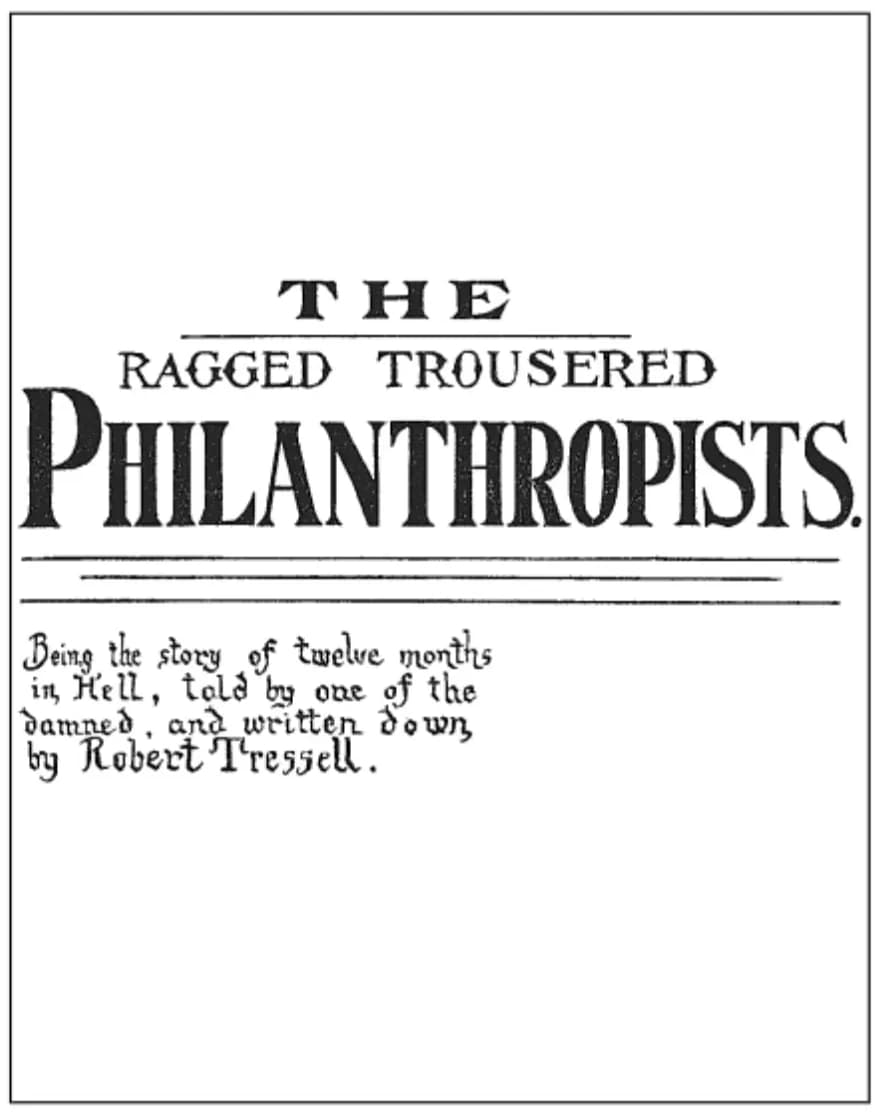
Between approximately 1906 and 1910, Tressell wrote his masterpiece, a novel of nearly 1,700 handwritten pages totalling roughly 250,000 words. The book depicts the fictional town of "Mugsborough," a thinly disguised portrait of Edwardian Hastings, and follows a group of house painters struggling against poverty and exploitation. The original title may have been "The Ragged Arsed Philanthropists," later toned down for publication. The manuscript was rejected by three publishers during Tressell's lifetime; it was only saved from destruction by his daughter Kathleen.
The "Great Money Trick" and Socialist Themes
The novel is best known for its "Great Money Trick" chapter, which illustrates Marxist theory of surplus value through a simple demonstration using pieces of bread. Tressell's book advocates for a socialist society and offers a powerful critique of capitalist exploitation. The work has been credited with influencing the Labour landslide victory of 1945 and remains a classic of working-class literature. George Orwell described it as "a book that everyone should read."
Political Activism in Hastings
Tressell was not merely a writer but an active socialist organiser. In 1906, he became a founder member of the Hastings branch of the Social Democratic Federation, with the initial meeting held at the Cricketers pub on South Terrace. Throughout 1906 and 1907, he attended outdoor SDF meetings and threw himself into branch work, helping to develop what the Robert Tressell Society describes as a "hard core of militant socialists." A photograph survives showing Tressell with his daughter Kathleen at a beach meeting near Queens Hotel.
Posthumous Publication and Recognition
Tressell died of pulmonary tuberculosis at Liverpool Royal Infirmary on 3 February 1911, aged 40, and was buried in a pauper's grave at Walton Park Cemetery. The first edition of The Ragged Trousered Philanthropists was published on 23 April 1914 by Grant Richards Ltd in an abridged form of 150,000 words. The unabridged edition did not appear until 1955, published by Lawrence and Wishart. By 2003, the book had sold over one million copies worldwide.
Hastings' Enduring Tribute
Today, Hastings honours its connection to Tressell through numerous commemorations. Robert Tressell Close is a residential street named after him, whilst Tressell Ward serves as both a political ward and a medical ward at Conquest Hospital in St Leonards-on-Sea. The University of Brighton's Hastings Campus includes Robert Tressell Halls of Residence. Noonan's Steps, a stepped passageway beside 115 Milward Road, bears his real surname.
Plaques and Memorials
Two blue plaques mark Tressell's former residences. The first was unveiled at 115 Milward Road on 2 June 1962 by Hastings Trades Council. A second plaque was unveiled at 241 London Road on 29 May 1999 by Michael Foster MP. The Robert Tressell Society, based at 4 Church Road in St Leonards-on-Sea, continues to preserve Tressell's material and archives, whilst Hastings Museum and Art Gallery maintains the local repository for his work.