Between 1901 and 1910, an Irish house painter living in Hastings wrote a novel that would become the most influential working-class book in British history. Robert Tressell's "The Ragged-Trousered Philanthropists" transformed the political consciousness of generations, yet it was composed in spare hours at a kitchen table in a modest West Hill flat.
The Man Behind the Pen Name
Robert Tressell was born Robert Phillipe Noonan in Dublin on 17 April 1870. His mother, Mary Noonan, was Roman Catholic; his father, Samuel Croker, was a retired Resident Magistrate and former Inspector of the Royal Irish Constabulary. The illegitimate son of this union, Noonan spent his early years in Ireland before emigrating to South Africa, where he worked as a painter and decorator and fathered a daughter, Kathleen, born in Cape Town in 1892.
It was in South Africa that Noonan encountered socialist ideas and developed the political convictions that would shape his life. Disillusioned by colonial society and seeking a fresh start, he arrived in Hastings in late 1901, probably around October or November. He chose the pen name "Tressell" from the trestle table, an essential part of any painter and decorator's equipment.
Hastings Addresses and Working Life
Tressell's first Hastings address was 38 Western Road, St Leonards, where he stayed with his sister Mary Jane Meiklejon. Soon after, he moved to 1 Plynlimmon Road, an end-of-terrace house on West Hill. This property now bears a blue plaque commemorating its famous resident. From late 1902 until approximately 1905 or 1906, he lived at 115 Milward Road, occupying the top flat at number 5 in 'Grosvenor Mansion'. A marble plaque marks this location, and the stepped passageway alongside is known locally as "Noonan's Steps".
His working life in Hastings was itinerant and poorly paid. At Bruce & Co, electrical and sanitary engineers with premises at 2 York Buildings (opposite what is now Macdonalds) and 40 Havelock Road, he looked after the ironmonger's shop and did signwriting for seven and a half pence an hour. He also worked for Burton & Co, undertakers and general painters at 88 Stonefield Road (now a plumbing shop), where his duties included writing coffin plates. Later employers included Adams & Jarrett of Norman Road, St Leonards and Alfred Street.
St Andrews Church and Surviving Work
One of Tressell's most substantial commissions was at St Andrews Church on Queens Road, where he decorated the chancel, completing the work by Easter 1905. The church has since been demolished; the site is now occupied by a Morrisons petrol station. Yet a fragment of Tressell's decorative painting survives in the collection of Hastings Museum and Art Gallery on Bohemia Road, the only physical evidence of his trade still extant.
Other houses he worked on included Val Mascal on Hollington Park Road, West Dene in Hollington Park, Filsham Lodge on Filsham Road, Kite's Nest on St Helens Park Road, and the Imperial pub on Queens Road. At 10 Stockleigh Road, St Leonards, he grained the front doors for Professor WCT Beasley. Signwriting he produced for Adams & Jarrett at 22 Gensing Road remained visible until it was painted over in 2006.
Political Awakening in Hastings
The 1906 general election radicalised Tressell. The Conservative candidate, Harvey du Cros, a Dunlop tyre millionaire, defeated the Liberals in a result that shocked the town's progressive elements. In September 1906, Tressell attended a meeting at The Cricketers pub on South Terrace to form a Hastings branch of the Social Democratic Federation. The first public meeting took place on 12 October 1906 at the Beehive Dining Rooms on Pelham Street.
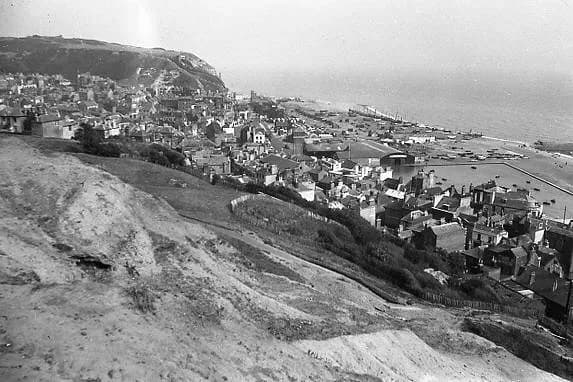
This political activity provided both the community and the material for his novel. The fictional "Mugsborough" of "The Ragged-Trousered Philanthropists" is transparently Hastings. Rushton & Co, the grasping employer in the book, corresponds to Bruce & Co. The tyrannical foreman, variously called Nimrod, Misery, or Hunter, was a composite of foremen at Bruce's and Burton's. The socialist character Frank Owen drew partly on Frederick Owen of the Hastings SDF, whilst Sweater the draper may have been modelled on Henry B Philpot, owner of Filsham Lodge.
The Cave and the Manuscript
The three-storeyed house under renovation that dominates the novel, known as "The Cave", almost certainly drew on Tressell's experiences at Val Mascal, West Dene, and Filsham Lodge in the Hollington Park area. Between approximately 1906 and 1910, working primarily at 115 Milward Road, Tressell produced a 1,600-page handwritten manuscript. The original title was "The Ragged Arsed Philanthropists".
Three publishing houses rejected the work. Tressell left Hastings in 1909, moving to a flat on London Road, then departed for Liverpool in August 1910 in a final attempt to secure publication and support his daughter. He died of pulmonary tuberculosis at Liverpool Royal Infirmary on 3 February 1911, aged 40, and was buried in a pauper's grave at Liverpool Parochial Cemetery. His daughter Kathleen had saved the manuscript from being burnt, keeping it in a metal box under her bed. The book was finally published, heavily abridged by Jessie Pope, in April 1914. An unabridged edition did not appear until 1955.
Hastings Remembers
Despite his lonely death far from Sussex, Hastings has claimed Tressell as its own. The town has named Robert Tressell Close after him, and the University of Brighton's Hastings Campus accommodation is called Robert Tressell Halls of Residence. Tressell Ward exists as a political division, and the Conquest Hospital at St Leonards-on-Sea has a Tressell Ward. The Robert Tressell Society maintains correspondence at 4 Church Road, St Leonards-on-Sea.
Visitors can still walk Noonan's Steps beside 115 Milward Road, read the plaques at Plynlimmon Road and Milward Road, and view the fragment of his church mural at Hastings Museum. The plumbing shop at 88 Stonefield Road, once Burton & Co's undertaking premises, still stands. These physical traces anchor one of British literature's most remarkable stories firmly in the streets of Hastings.